What is the best way to quote a catering job without losing your margin?
Catering quotes fail when they are built from restaurant menu prices instead of event-specific costs. Here is a costing approach that holds up when the guest count changes.
Why restaurant menu prices are the wrong starting point
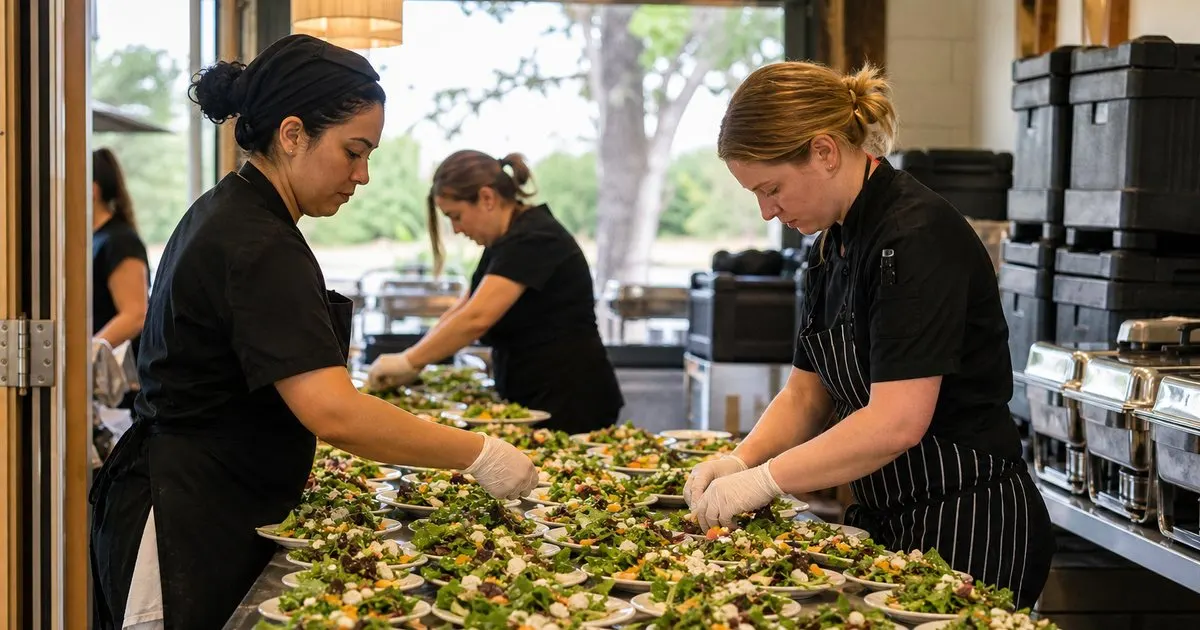
The reflex when a catering inquiry comes in is to open the restaurant menu and multiply. That usually produces a number that is either too high to win the job or too low to make money, because a catering plate and a restaurant plate are not the same product. In the dining room, the price carries rent, front-of-house labor, and a dish that is fired to order. At an event, you carry transport, rentals, disposables, staff travel time, and the risk that the count changes the day before. Related: How should you price a menu using both plate cost and target margin?
Start instead from a fresh recipe for the event menu, scaled to the expected headcount, with every component costed at current prices. Batch cooking changes yields and portion sizes: a braise for 150 behaves differently from six covers on a Tuesday, and a buffet portion is not a plated portion. Costing the event as its own set of recipes, rather than borrowing from the menu, is the single biggest improvement most kitchens can make to catering profitability.
Keep reading: How do you cost a recipe accurately down to the true plate cost?, What is food cost percentage and why does it matter for a menu?, How should you price a menu using both plate cost and target margin?. See how PlateCostr helps you recipe food-cost and menu margin calculator.
Building the quote from plate cost upward
Cost the food first, per person, using the scaled recipes. Then add the non-food costs that scale with headcount: disposables, linens, rental flatware, and beverage. Then add the costs that do not scale, such as delivery, setup, breakdown, and any kitchen rental or permit. Divide the fixed costs by the guaranteed minimum count, not the hoped-for count, so a smaller turnout does not erase your margin. Related: How do you protect margins when ingredient prices keep rising fast?
Labor deserves its own line. Estimate prep hours, event hours, and travel, multiply by loaded wage rates, and include it in the per-person cost before you apply any markup. Many caterers price food at a target food cost percentage and then discover the labor for a plated dinner ate the difference. Once food, scaling costs, fixed costs, and labor are all in, apply the margin you need on top, and only then compare the number to what the market will bear. Related: What is food cost percentage and why does it matter for a menu?
Protecting the number when the details move
Catering quotes are living documents. The client changes the menu, the count shifts, the venue adds a rule about open flame. Write the quote so that every change has a defined effect: a per-person price above a guaranteed minimum, a separate line for staffing that adjusts with hours, and a clause that menu substitutions are re-costed. Nothing protects margin better than a quote where the client can see how the price is built.
Keep the costed recipes attached to the quote so you can answer questions quickly. If the client asks to swap a protein, you should be able to see the plate cost change in minutes and reply with a real number rather than a guess. This is the practical case for a costing tool over a stack of spreadsheets: the event recipes, the scaled quantities, and the current ingredient prices are already in one place. Related: How do you cost a recipe accurately down to the true plate cost?
Learning from every event you run
After the event, compare what you quoted against what you spent. Pull the invoices for that job, count what came back untouched, and note where the labor ran long. Most kitchens find the same two or three leaks show up repeatedly, such as overproduction on buffet items or underestimated setup time, and those are easy to fix in the next quote.
Over time, this builds a library of proven event menus with known costs, known labor, and known waste. New inquiries get quoted from real history instead of from optimism, and a sales conversation can start from a menu you already know how to execute at a margin you already trust. That is how catering becomes a dependable contributor to the business rather than a seasonal source of surprises.
- Do not multiply restaurant menu prices; cost each event as its own scaled set of recipes.
- Separate per-person costs, fixed costs, and labor, and spread fixed costs over the guaranteed minimum count.
- Write quotes so that count changes, menu swaps, and extra hours have defined price effects.
- Reconcile every event against invoices and labor to build a library of proven, costed event menus.

Julien Jimenez
Julien Jimenez is an independent software builder based in Paris. He designs, ships, and operates focused SaaS products for small businesses and independent professionals. Read the full author page.
Know The True Cost Of Every Plate
Recipe food-cost and menu margin calculator. PlateCostr is built to help you put this into practice.
Start free trialMore from the PlateCostr blog

How do you cost a recipe accurately down to the true plate cost?

What is food cost percentage and why does it matter for a menu?

How should you price a menu using both plate cost and target margin?
Get the PlateCostr playbook
Practical guides on menu costing and margin, straight to your inbox as we publish them. No spam, unsubscribe any time.